Best Wood for Building an Outdoor Sauna in the UK
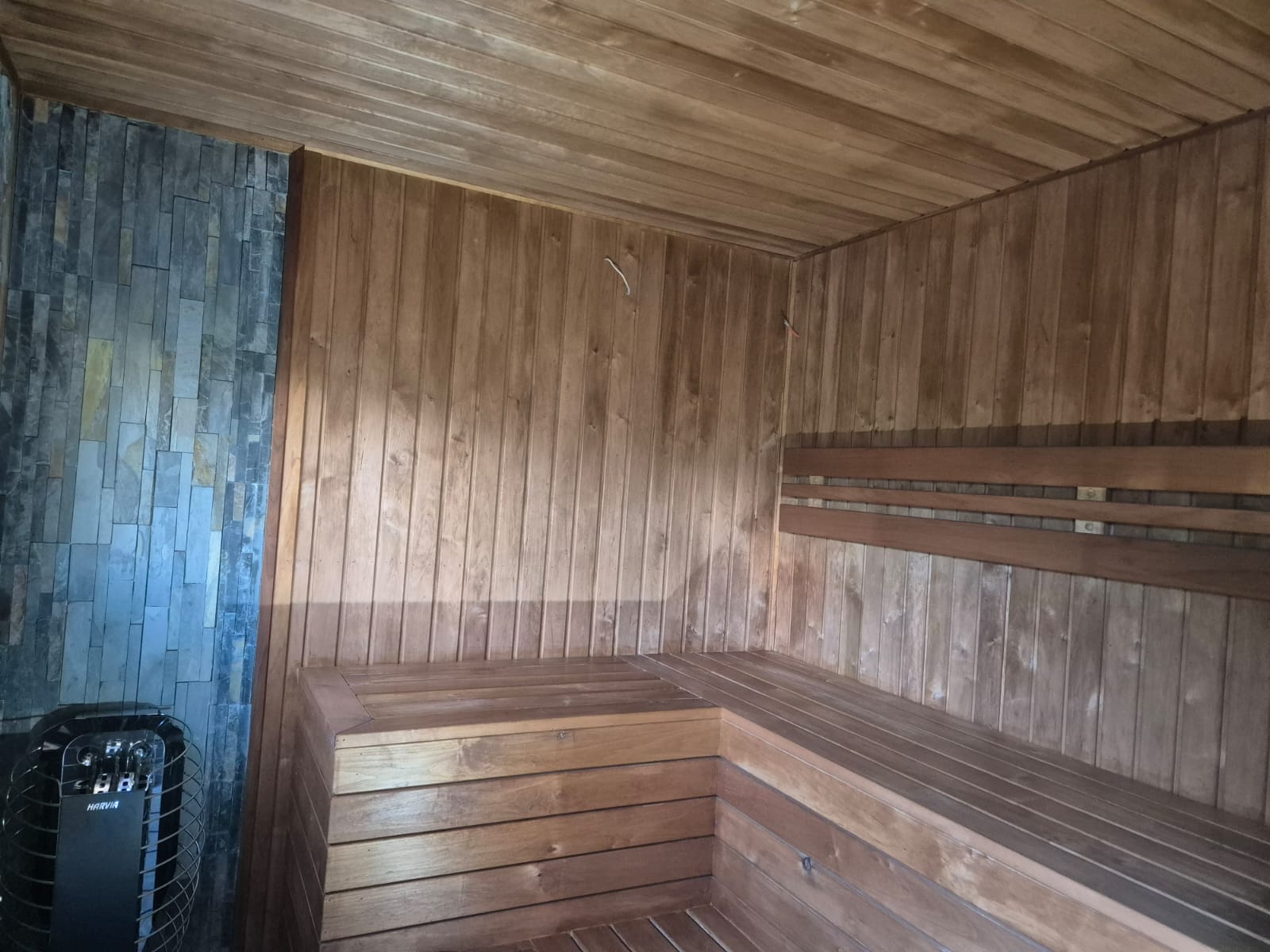
After researching extensively and building my own garden sauna, here's what I learned about choosing wood for UK conditions. I'll cover what works for exteriors and interiors, what I actually used, and what I'd recommend based on a year of real-world use.
Quick Answer: For UK climate, use treated softwood or Thermowood for exterior cladding (with proper paint/stain protection), and Thermo-aspen, Thermo-alder, or Western Red Cedar for interior (£17-28/m²). The interior wood is where quality really matters - don't cheap out on it.
What I Actually Used
Before diving into options, here's what I used on my build and how it's held up after a year:
| Location | Material | Supplier | Notes |
|---|---|---|---|
| Exterior cladding | 6x1 softwood planks, painted + stained | Local timber merchant | Wanted natural look, not dark thermowood |
| Interior walls & ceiling | Thermo-aspen (Thermory brand) | SaunaShop.co.uk | Dark, beautiful, easy to fix |
| Benches | Thermo-alder (Thermory brand) | SaunaShop.co.uk | Couldn't get aspen in right profile |
| Floor | Porcelain tiles | - | Matched external patio |
One year on: Everything looks great. No issues with the exterior despite British weather. Interior has darkened slightly (normal for thermo-treated wood) and still smells wonderful.
The Two Key Decisions
1. Exterior Cladding
Faces British weather: rain 150+ days/year, temperature swings, UV. Needs durability and rot resistance - or proper protection.
2. Interior Lining
Faces heat (80-100°C), humidity swings, skin contact. Needs low heat conductivity, won't splinter, pleasant smell. This is where you really feel the quality.
These require DIFFERENT woods with different properties. Let's break down each.
Exterior Cladding Options
1. Treated Softwood with Paint/Stain (What I Used) ★★★★☆
What is it? Standard softwood planks (pine, spruce) with proper paint and stain protection.
| Property | Rating | Notes |
|---|---|---|
| Durability (UK climate) | ★★★★☆ | 15-20+ years with maintenance |
| Rot resistance | ★★★☆☆ | Depends entirely on finish quality |
| Appearance | ★★★★★ | You choose the colour/finish |
| Cost | ★★★★★ | £8-12/m² + paint/stain |
✓ Pros:
- Much cheaper than thermowood
- Choose any colour to match your garden
- Natural wood look if you use clear stain
- Easy to source from any timber merchant
- Easy to repair/repaint if damaged
✗ Cons:
- Needs proper paint/stain application
- Will need maintenance every few years
- Quality depends on your prep work
What I Used - Exact Products:
Paint (2 coats, sprayed): Cuprinol Ducksback - protects sheds and fences for up to 5 years. Works brilliantly, easy to apply with a sprayer.
Clear stain (exterior faces): V33 750ml Clear Satin Solvent-Based Exterior Wood Stain (Screwfix, ~£15). Excellent product. Light sanding before application.
Tip: Coat ALL faces of the wood before installation - including the back that faces the wall. This prevents moisture getting in from behind.
One year on: Looks fantastic. Exactly the natural look I wanted, matching existing garden structures.
2. Thermowood (Thermally Modified Timber) ★★★★★
What is it? Softwood (usually pine or spruce) heat-treated at 180-230°C. Changes wood structure to resist rot and moisture.
| Property | Rating | Notes |
|---|---|---|
| Durability (UK climate) | ★★★★★ | 25-30 year lifespan |
| Rot resistance | ★★★★★ | Excellent - Class 1 |
| Moisture stability | ★★★★★ | 50% less movement than untreated |
| Appearance | ★★★★☆ | Rich brown, darkens with age |
| Cost | ★★★☆☆ | £24/m² (21x95mm profile) |
✓ Pros:
- Perfect for UK's wet climate
- Dimensionally stable (won't cup/warp)
- No treatment needed - heat process is the treatment
- Eco-friendly (chemical-free)
- Beautiful charcoal-brown colour
✗ Cons:
- More expensive than standard timber
- Slightly more brittle (use pilot holes)
- Can silver-grey if left untreated (not rot, just aesthetics)
- Dark colour - if you want a lighter/natural wood look, you're stuck with brown
Why I didn't use it: I wanted my sauna to match existing garden structures which have a natural wood finish. Thermowood's dark brown colour didn't fit my aesthetic. But if you want low-maintenance and don't mind the colour, it's probably the best exterior option.
UK Suppliers:
- Thermowood UK - £24/m²
- International Timber - £22/m²
- Travis Perkins (special order) - £26/m²
2. Western Red Cedar ★★★★☆
What is it? Naturally rot-resistant softwood from North America. The "traditional" sauna wood.
| Property | Rating | Notes |
|---|---|---|
| Durability (UK climate) | ★★★★☆ | 20-25 years with maintenance |
| Rot resistance | ★★★★☆ | Good - natural oils protect |
| Moisture stability | ★★★☆☆ | Better than pine, still moves |
| Appearance | ★★★★★ | Beautiful red-brown, weathers to silver |
| Cost | ★★★☆☆ | £18-22/m² |
✓ Pros:
- Beautiful natural colour
- Pleasant cedar smell
- Naturally rot-resistant
- Widely available in UK
- Easy to work with
✗ Cons:
- Weathers to grey (needs oil to maintain colour)
- More expensive than treated softwoods
- Can still cup/warp in very wet areas
- Colour fades over time
Best for: People who love traditional sauna aesthetic, willing to oil annually, drier regions of UK.
UK Suppliers:
- Brooks Bros - £18/m²
- UK Saunas - £20/m²
- Lawsons - £22/m² (special order)
3. Siberian Larch ★★★☆☆
What is it? Dense European softwood with high natural resin content.
| Property | Rating |
|---|---|
| Durability | ★★★★☆ (15-20 years) |
| Cost | ★★★★☆ (£14/m²) |
| UK Climate | ★★★☆☆ (okay, not great) |
✓ Pros: Cheaper than cedar, harder/denser than pine, naturally rot-resistant
✗ Cons: Still needs treatment in UK climate, prone to splitting, can twist
Best for: Budget builds in drier UK regions. Needs annual oil/stain.
4. Pressure-Treated Softwood ★☆☆☆☆
Don't use for saunas. The chemicals can off-gas when heated. Only use for frame/base that won't be heated.
Interior Lining Options
Interior wood needs completely different properties: low thermal mass (won't burn you), won't splinter, handles moisture swings, pleasant when heated.
1. Western Red Cedar ★★★★★
The gold standard for sauna interiors.
| Property | Rating | Notes |
|---|---|---|
| Heat conductivity | ★★★★★ | Low - won't burn skin |
| Moisture resistance | ★★★★★ | Handles humidity perfectly |
| Aroma | ★★★★★ | Pleasant cedar smell |
| Splinter resistance | ★★★★☆ | Generally smooth |
| Cost | ★★☆☆☆ | £28/m² tongue & groove |
Grades:
- Clear Grade (£28/m²) - No knots, premium
- Knotty Grade (£17/m²) - Small knots, still good quality
✓ Pros: Perfect thermal properties, smells amazing, looks beautiful, lasts forever, traditional
✗ Cons: Expensive, can darken over time, some people find smell too strong
2. Thermo-Aspen (What I Used) ★★★★★
My top recommendation. Thermory brand thermo-aspen is what I used for walls and ceiling.
| Property | Rating | Notes |
|---|---|---|
| Heat conductivity | ★★★★★ | Excellent - stays cool to touch |
| Appearance | ★★★★★ | Beautiful dark brown, very uniform |
| Durability | ★★★★★ | Heat treatment = rot-proof |
| Ease of installation | ★★★★★ | Tongue & groove, very easy |
| Cost | ★★★☆☆ | £22-28/m² |
Why I Chose Thermo-Aspen
I wanted a dark, modern interior rather than the traditional light Scandinavian look. Thermory's thermo-aspen is genuinely excellent quality - the boards arrived perfectly straight, uniform colour, and fitted together beautifully.
Supplier: SaunaShop.co.uk - same product from Thermory, well-packaged, no damage. There are other UK suppliers but they all stock the same Thermory product.
Waste: I ordered 10% extra to allow for cuts and mistakes - this was plenty.
✓ Pros:
- Absolutely beautiful dark finish
- Heat treatment means it's incredibly stable
- Won't rot, warp, or crack
- Very easy to install - tongue and groove clicks together
- Thermory is premium quality - boards arrive perfect
- Subtle pleasant smell (not overpowering like cedar)
✗ Cons:
- More expensive than untreated options
- Dark colour not for everyone (if you want light/bright, use regular aspen)
- Slightly more brittle than untreated wood
3. Thermo-Alder (For Benches) ★★★★★
Excellent for bench construction - what I used for my benches.
I couldn't source thermo-aspen in the right profile for bench slats, so I used thermo-alder instead. Honestly, it looks almost identical - slightly different grain pattern but same dark colour. Both are Thermory products, both excellent quality.
Tip: Check what profiles are available in each wood before committing. SaunaShop.co.uk have a good range, but some sizes are only available in certain species.
4. Canadian Hemlock ★★★★☆
The budget alternative to cedar.
| Property | Rating |
|---|---|
| Heat conductivity | ★★★★☆ |
| Moisture resistance | ★★★★☆ |
| Cost | ★★★★☆ (£20/m²) |
✓ Pros: Cheaper than cedar, light colour, minimal odour, good thermal properties
✗ Cons: Less character than cedar, can discolour near heater
Woods to AVOID for Interiors
- Pine: Too much resin - sweats and smells bad when heated
- Oak/Hardwoods: Too dense - will burn your skin at sauna temps
- Treated timber: Chemicals off-gas when heated - dangerous
- MDF/Plywood: Will delaminate with moisture, glue off-gasses
My Build: What I Used & Why
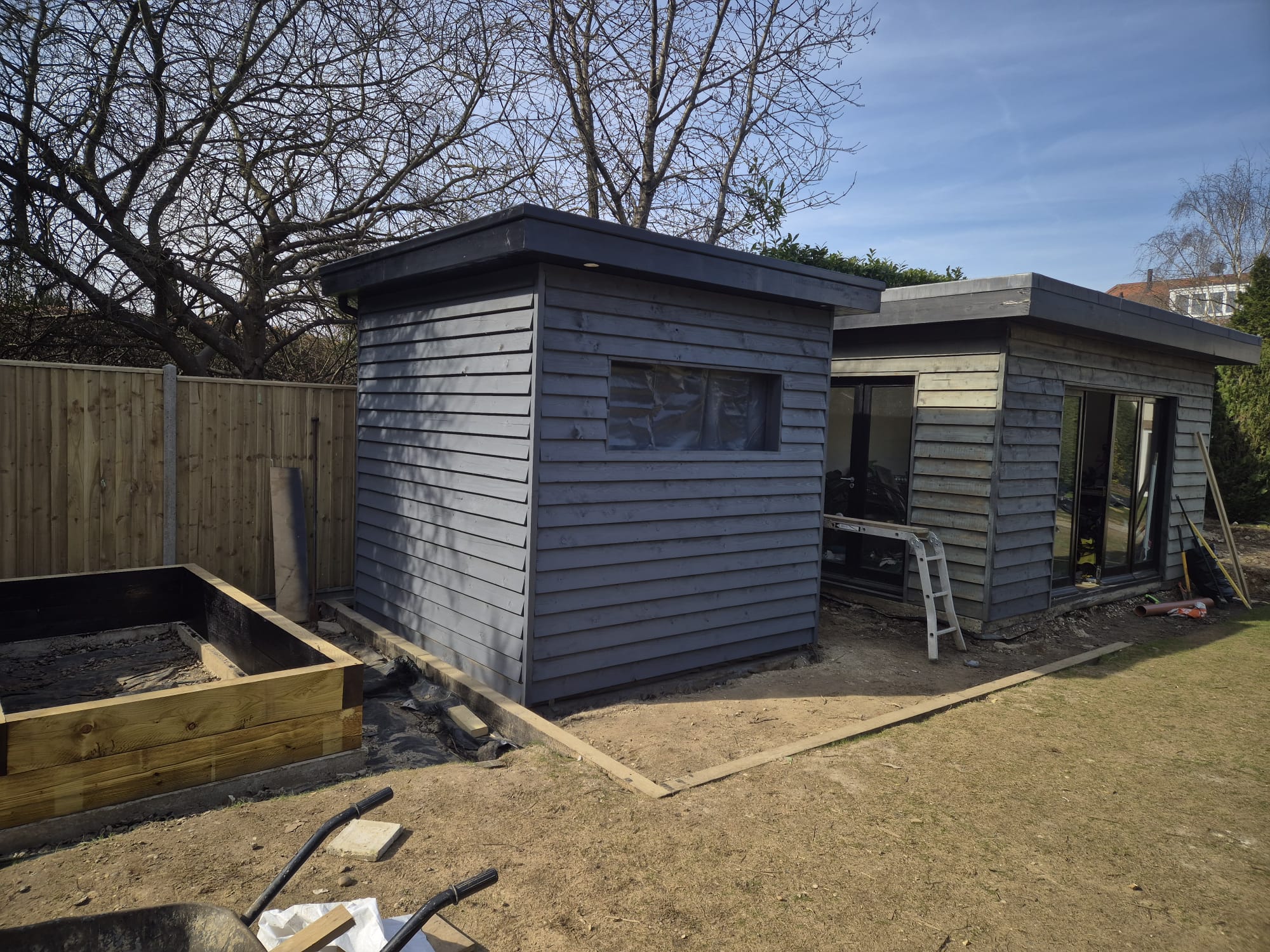
Exterior: 6x1 Softwood Planks (Painted + Stained)
- Cost: ~£400 for timber + paint/stain
- Products: Cuprinol Ducksback (2 coats, sprayed) + V33 Clear Satin Exterior Wood Stain (Screwfix)
- Why: I wanted the natural wood look to match existing garden structures, not the dark brown of thermowood
- Result: Looks fantastic one year on. Exactly the aesthetic I wanted.
Key tip: Paint/stain ALL faces before installation, including the back face. This prevents moisture getting in from behind.
Interior Walls & Ceiling: Thermo-Aspen (Thermory)
- Cost: ~£700 for walls and ceiling
- Supplier: SaunaShop.co.uk (same Thermory product available from several UK suppliers)
- Why: Wanted a dark, modern interior. Thermory quality is exceptional.
- Result: Absolutely beautiful. Easy to fit. Has darkened slightly (normal) and smells wonderful.
Benches: Thermo-Alder (Thermory)
- Cost: ~£180 for bench timber
- Why: Couldn't source thermo-aspen in the right bench slat profile, so used thermo-alder instead
- Result: Looks almost identical to the aspen walls. Comfortable, stays cool enough to sit on.
Floor: Porcelain Tiles
- Matched external patio tiles so it all flows together
- Added granite skirting upstand to protect bottom of wall panels from water
Total wood cost: ~£1,280
Would I change anything? Honestly, no. The combination works perfectly - natural look outside, dark modern interior. The thermo-treated interior wood is genuinely excellent quality.
Installation Tips
Acclimatisation
Let interior wood acclimatise in a dry shed for about a week before fitting. Don't leave it outside or in a damp garage.
Fixing Method: Nail Gun vs Hidden Fixings
Thermory recommend hidden fixings for their interior panels, but I used a nail gun with fine nails - much, much faster and less fiddly. You really can't see the nail heads once the wood swells slightly. Don't stress about hidden fixings unless you're obsessive about it.
Pro Tip: Chalk Line for Neat Nailing
Snap a chalk line along each board to mark where the framing is behind. Then nail along this line - you get perfectly aligned nail heads and guaranteed fixing into the studs. Looks much neater than eyeballing it.
How Much Extra to Order
I ordered 10% extra for cuts and mistakes - this was plenty. The Thermory product arrived with no damaged boards, so I actually had some left over. Better to have spares than run short mid-project.
Cost Comparison (Per m²)
| Wood Type | Use | Cost/m² | Lifespan |
|---|---|---|---|
| Painted softwood | Exterior | £12-18 (inc. paint) | 15-20+ years with maintenance |
| Thermowood | Exterior | £24 | 25-30 years |
| Thermo-Aspen/Alder | Interior | £22-28 | Lifetime |
| Western Red Cedar | Both | £18-28 | 20-25 years |
| Siberian Larch | Exterior | £14 | 15-20 years |
| Hemlock | Interior | £20 | 20+ years |
UK Climate Considerations
Our weather is uniquely challenging:
What Makes UK Climate Tough for Wood
- Rain: 150+ days/year in most regions
- Humidity: 75-85% average (encourages rot)
- Temperature swings: -5°C to +30°C annually
- Limited sun: Less UV drying than continental climates
What This Means for Your Sauna
- Exterior needs Class 1 or 2 durability rating OR proper paint/stain protection
- Natural rot resistance essential (or thermowood treatment, or painted protection)
- Proper ventilation gap behind cladding critical
- Regular maintenance more important than in dry climates
Where to Buy in the UK
Interior Sauna Wood (Thermory, Aspen, Alder, Cedar)
- SaunaShop.co.uk - What I used. Excellent Thermory products, well-packaged, no damage. Highly recommended.
- UK Saunas - Cedar T&G, sauna-specific products
- Other Thermory stockists - All UK suppliers stock the same Thermory product from Estonia, so shop around on price
Exterior Cladding (Thermowood, Cedar, Larch)
- Thermowood UK - Best for thermowood, nationwide delivery
- Brooks Bros - Western Red Cedar specialist
- International Timber - Large selection, good prices
- Local timber merchants - Often cheaper for standard softwood planks
General Builders Merchants
- Travis Perkins - Can special-order cedar/thermowood
- Jewson - Limited selection, check availability
- Lawsons - Good for larch, can order cedar
- Screwfix - Great for finishes (V33 wood stain, etc)
Buying Tips
- Order 10% extra for cuts/waste
- Inspect on delivery - don't accept damaged boards
- Acclimatise wood on-site for 48 hours before installation
- Buy from same batch to ensure colour match
Maintenance Requirements
Thermowood Exterior
- Year 1-5: Nothing required
- Year 5+: Optional oil if you want to maintain colour (otherwise silvers naturally)
- Lifespan: 25-30 years untreated
Cedar Exterior
- Annual: Clean + oil if maintaining colour
- Or: Leave to weather grey naturally (still protected)
- Products: Osmo UV-Protection Oil (£45/2.5L)
Cedar Interior
- No treatment needed - sauna heat "self-treats"
- Monthly: Wipe benches with damp cloth
- Bi-annual: Light sand on benches to refresh
Common Questions
Can I use standard fence panels?
No. They're pressure-treated softwood that will off-gas chemicals when heated. Also too thin and won't last.
Can I mix wood types?
Yes! Many people use thermowood exterior + cedar interior (like I did). Just don't mix within same surface.
Do I need to treat the wood?
Exterior cedar benefits from annual oil. Thermowood and interior cedar need no treatment.
What about reclaimed wood?
Risky. You don't know if it's been treated with chemicals. Only use if 100% certain it's untreated cedar/similar.
How much do I need?
Measure your sauna's surface area and add 10%. For a 2.4m x 2.1m sauna:
- Exterior cladding: ~45m²
- Interior lining: ~28m²
- Bench slats: ~3.5m of 45x70mm boards
Final Recommendations
Budget Build (£900 timber cost)
- Exterior: Siberian Larch + annual treatment
- Interior: Hemlock T&G
- Benches: Hemlock
Best Value (£1,200 timber cost)
- Exterior: Thermowood (no maintenance)
- Interior: Knotty Cedar T&G
- Benches: Clear Cedar
Premium (£1,800 timber cost)
- Exterior: Clear Cedar (oil annually for colour)
- Interior: Clear Cedar T&G
- Benches: Clear Cedar
Bottom Line
For UK climate, don't compromise on exterior durability. Thermowood or Western Red Cedar are your best options - anything else will need constant maintenance or won't last.
For interior, cedar is worth the premium for the smell and feel, but hemlock or aspen work fine if budget is tight.
The extra £400-600 for quality wood vs cheap alternatives will save you thousands in repairs and replacement within 5-10 years.
← Back to Home